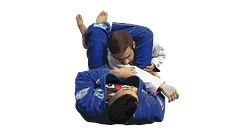
Flying Triangle

Submission
The flying triangle is an airborne submission where the attacker jumps from standing to lock a triangle choke around a standing or kneeling opponent's head and arm. It is used when the opponent offers a same-side collar-and-sleeve or underhook grip that creates an opening for the attacker to launch and isolate one arm inside the triangle configuration.
Quick Reference
Key principles
- · Controlling one arm (pulling it across or pinning it) before jumping ensures the correct arm is trapped inside the triangle.
- · The hip-to-shoulder level change and explosive upward jump are driven by pulling the opponent's posture down while climbing the hips high onto the neck.
- · Locking the triangle in the air—diamond or figure-four—before reaching the ground prevents the opponent from posturing out or stacking.
- · Angling off to the choking side once grounded maximizes carotid compression and removes stacking leverage.
- · If the opponent resists by keeping posture tall, converting to an armbar from the triangle position is the primary contingency.
Execution
- 1 From standing, secure a strong grip on the opponent's same-side wrist or sleeve and an opposite-side collar, lapel, or neck tie to control posture and distance.
- 2 Step your foot onto the opponent's same-side hip (the side of the trapped arm), pull their posture forward and down, then explosively jump, swinging your free leg over and behind their neck.
- 3 In the air, clamp both legs tight—one leg across the back of the neck and the other hooking under the trapped arm—and lock the triangle by placing the knee-pit of the neck-side leg over the ankle of the other leg.
- 4 As you descend, angle your body perpendicular to the opponent, pull the trapped arm across your centerline, and squeeze your knees together while lifting your hips to finish the choke.
Common mistakes
- × Jumping without first controlling and isolating one arm, resulting in both arms inside the legs and no choke.
- × Failing to climb the hips high enough on the jump, landing at chest level instead of the neck, which lets the opponent posture up and slam or stack.
- × Not angling off after landing, staying square underneath the opponent, which allows them to stack pressure and nullifies the choke.
Common defenses
How opponents shut the Flying Triangle down.
Related Courses

Flying Triangle Submission Statistics
Gi vs No-Gi Distribution
Gi
19
(67.9%)
Nogi
9
(32.1%)
Most Flying Triangle Finishes
RNK
ATHLETE
WINS
1

Flying Triangle Historical Trends
Percentage of All Submissions
2017
2018
2019
2020
2021
2022
2023
2024
2025
2026
Percentage (%)
Year
Gi
Nogi
Showing the percentage of submissions won using Flying Triangle relative to all submission victories in Gi and No-Gi contests