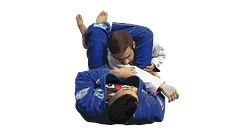
Triangle From Closed Guard
Submission
Also known as:
Closed Guard to Triangle
The triangle choke applied from closed guard by enclosing the opponent's head and one arm between your legs, creating a figure-four leg configuration that compresses the carotid arteries. It is one of the highest-percentage submissions from closed guard, typically set up when you can isolate one of the opponent's arms and create an angle.
Quick Reference
Key principles
- · Control one arm in and one arm out to create the asymmetry needed for the choke.
- · Cutting a sharp angle by pivoting your hips to the choking side dramatically increases finishing pressure.
- · Pulling the head down while squeezing your knees together closes any remaining space around the neck.
- · The choking leg's hamstring must press across the back of the neck, not across the shoulders or upper back.
- · If the opponent postures up or stacks, underhook their leg or re-angle your hips to maintain control and prevent escape.
Execution
- 1 From closed guard, control both wrists; push one arm across your centerline to the mat while pulling the other arm toward you, breaking their posture.
- 2 Open your guard, place one foot on their hip for leverage, and shoot the opposite leg high over their neck on the isolated-arm side while clamping the other leg under their trapped arm.
- 3 Lock the triangle by placing the crook of your top leg's knee over the ankle of your bottom leg, squeezing your knees together.
- 4 Pivot your hips perpendicular to the opponent, pull their head down with both hands, and squeeze your thighs while lifting your hips to finish the choke.
Common mistakes
- × Failing to cut an angle causes the choke to land on the chin or jaw rather than the neck, allowing the opponent to endure and work an escape.
- × Locking the triangle too loosely or too low on the shoulders gives the opponent space to posture up and begin stacking to pass.
- × Not controlling the trapped arm across your body lets the opponent use that hand to create a frame inside the triangle and relieve choking pressure.
Do it from
Positions and situations where the Triangle From Closed Guard shows up.
Closed Guard Bottom
Common defenses
How opponents shut the Triangle From Closed Guard down.
1 less common
Chains & Sequences
Commonly taught paths through the graph that feature this technique.
Kimura to Triangle from Closed Guard