Reverse Triangle


Reverse Triangle on the Digitsu Graph
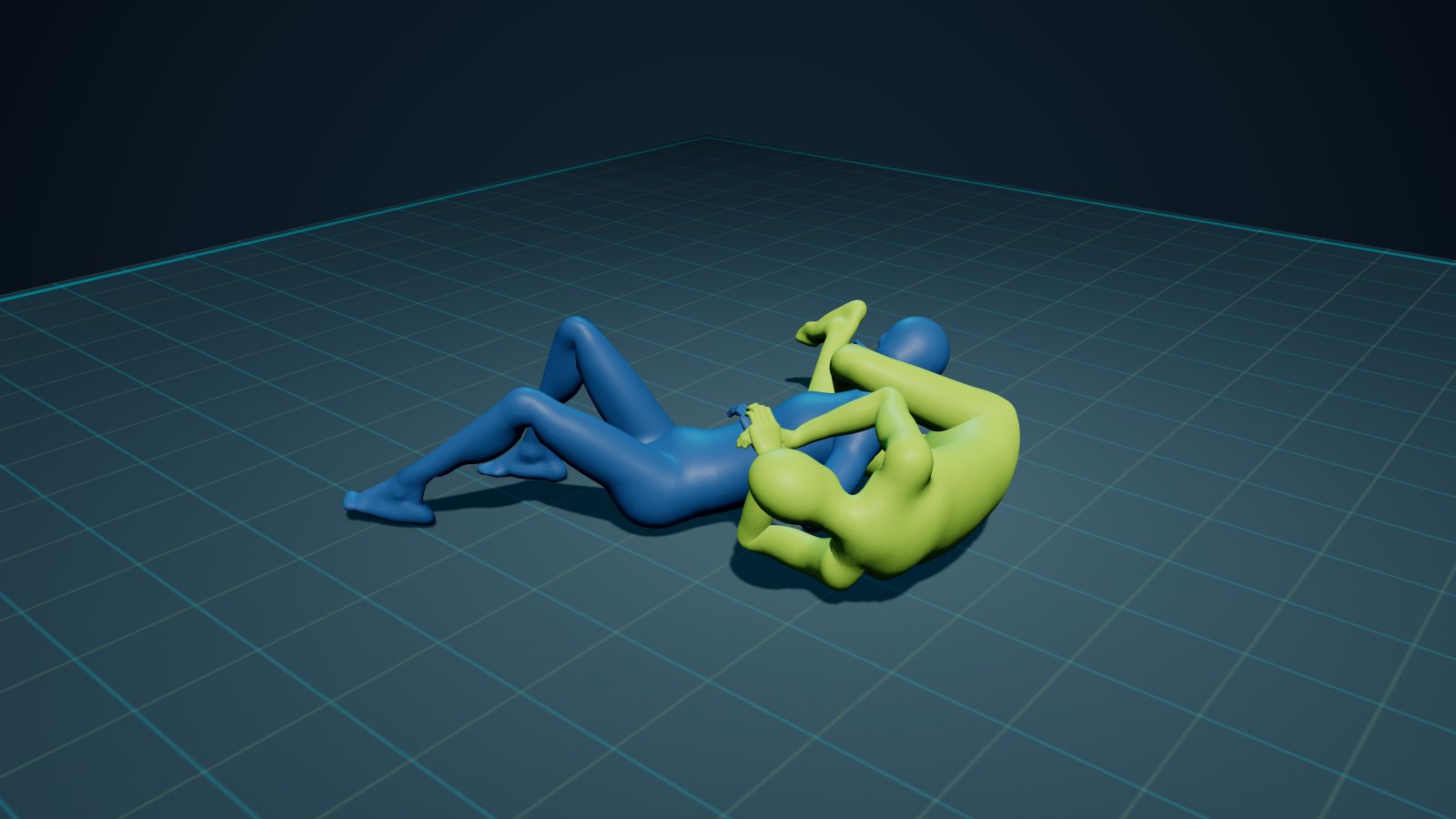
Submission
Also known as:
Reverse Triangle Choke
Reverse Triangle Americana
The reverse triangle is a choking submission applied from open guard bottom where the legs encircle the opponent's head and one arm from the opposite direction compared to a standard triangle—the lock is configured behind the opponent's head rather than in front. It often arises when the opponent postures or turns away during guard retention, exposing the reverse angle.
Quick Reference
Key principles
- · The choking mechanism is identical to a standard triangle—one arm in, one arm out—but the figure-four lock closes behind the opponent's neck rather than in front.
- · Angling your hips to the side is critical to tighten the choke and eliminate space.
- · Pulling the trapped arm across the opponent's centerline (like an Americana grip) dramatically increases finishing pressure.
- · Control the opponent's posture by pulling their head down with your hands or overhooking their trapped arm to prevent them from stacking or posturing out.
- · Squeezing your knees together while extending your hips generates the primary strangling force.
Execution
- 1 From open guard, when the opponent turns or postures, throw one leg over the back of their neck while the other leg controls one arm inside the triangle.
- 2 Lock the figure-four by placing the crook of one knee behind the other foot, securing the configuration behind the opponent's head.
- 3 Angle your body approximately 45 degrees to the side of the trapped arm to tighten the triangle and eliminate slack.
- 4 Grip the opponent's trapped wrist and pin or rotate it across their body (Americana-style) to close remaining space around the neck.
- 5 Squeeze your knees together, lift your hips, and pull down on the head or arm to finish the choke.
Common mistakes
- × Failing to angle the hips off-center, which leaves too much space around the neck and results in a loose, ineffective choke.
- × Locking the triangle too high on the opponent's shoulders instead of snugly around the neck, allowing them to breathe and posture out.
- × Neglecting to control the trapped arm—leaving it free lets the opponent frame, create space, and escape the submission.
Do it from
Positions and situations where the Reverse Triangle shows up.
Show 1
Open Guard Bottom
Reverse Triangle Submission Statistics
Gi vs No-Gi Distribution
Gi
24
(42.9%)
Nogi
32
(57.1%)
Most Reverse Triangle Finishes
RNK
ATHLETE
WINS
1

4
Tiffany Butler
2
Reverse Triangle Historical Trends
Percentage of All Submissions
2017
2018
2019
2020
2021
2022
2023
2024
2025
2026
Percentage (%)
Year
Gi
Nogi
Showing the percentage of submissions won using Reverse Triangle relative to all submission victories in Gi and No-Gi contests