Carlson Gracie


Start your 7-day free trial
Full access to every course, technique breakdown, and Sudo — your AI training partner. 7 days free, cancel anytime.
Card required • 7 days free, then your plan auto-renews • Cancel anytime.
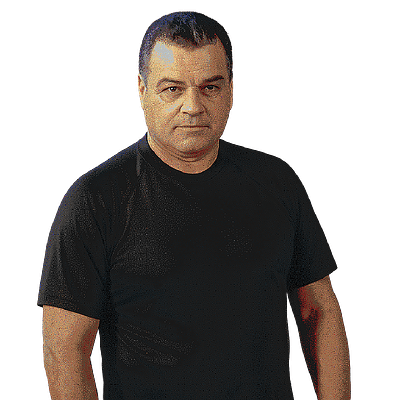
Carlson Gracie
Submit Information
Help us enhance our database with additional details or corrections.
Early Life and the Making of a Gracie Fighter
Carlson Gracie was born on August 13, 1932 in Rio de Janeiro, Brazil, the son of Carlos Gracie, the founder of Gracie Jiu-Jitsu. Immersed in the family's martial arts culture from birth, he made his competitive debut at the remarkable age of five at the Campeonato Aberto de Jiu-Jitsu e Luta Livre — an open tournament contested between Jiu-Jitsu and Submission Wrestling practitioners. That early exposure to competition set the tone for a life entirely defined by fighting.
Academic pursuits took a back seat to the family mission. Alongside his uncles, Carlson traveled extensively across Brazil, demonstrating and promoting the Gracie Jiu-Jitsu legacy in cities far from Rio. The demands of that itinerant life made formal schooling impractical, and by 15 he had left school entirely to dedicate himself to fighting. Two years later, at 17, he claimed Rio de Janeiro's first-ever state title by winning the Campeonato Carioca de Jiu-Jitsu — a result that announced his arrival as a serious competitor.
His first professional fight came at 18, when he faced Sakai, a Judo specialist weighing 92 kilograms, while Carlson competed at just 67 kilograms. Contested under grappling rules with no strikes permitted, the bout ended in a draw — neither man could secure a submission within the time limit. That debut revealed both his fearlessness and the physical disadvantages he would repeatedly overcome throughout his career.
Vale Tudo Career and the Waldemar Santana Rivalry
Throughout the 1950s and 1960s, Carlson Gracie established himself as one of Brazil's most formidable No Holds Barred and Vale Tudo competitors. Following the draw with Sakai, he issued a public press challenge to anyone in the country willing to face him, with the fight's proceeds earmarked for victims of a severe drought devastating Brazil's Northwest region. The man who answered was Cirandinha, a Capoeira fighter weighing 100 kilograms. Carlson dispatched him by verbal tap out, finishing with strikes from the mount — an early demonstration of the top-pressure game that would become his signature.
No rivalry defined Carlson's competitive career more than his series of fights against Waldemar Santana, a fearsome competitor who had previously knocked out Carlson's uncle Helio Gracie. The personal and family stakes could not have been higher. Before their first encounter, Carlos Gracie publicly declared he would pay 300,000 reais — an extraordinary sum at the time — if Santana could survive Carlson's superior technique. Santana responded with a disciplined defensive effort, avoided submission, and claimed the wager in a fight ruled a draw.
The rematch elevated the rivalry to national theater. Held at a sold-out Maracanãzinho in Rio de Janeiro before 40,000 spectators, Carlson secured the decisive victory he had pursued so relentlessly, defeating Santana with strikes from the mount and restoring the Gracie family's honor. The full scope of their rivalry, however, extended well beyond those most-discussed bouts. Carlson himself stated that the two men fought a total of six times — with Carlson winning two and the remaining four ending in draws — a more complete record than accounts focusing only on their most prominent meetings. Carlson reigned as one of Brazil's most dominant combat sports figures for nearly 30 years, a span that cemented his status as the defining Brazilian fighter of his era.
Training Philosophy and Vale Tudo Methodology
Conditioning and Structural Preparation
Carlson Gracie's approach to preparation was as unconventional as it was effective, forged through competitive necessity and refined into a coherent system. His physical conditioning was deliberately functional: running on beach sand, extensive jump rope work, and hiking the hillsides and dunes of Rio de Janeiro built the engine that powered his fights.
The Sparring System
In an interview conducted in the 1990s by then-purple belt reporter Luca Atalla for Graciemag, Carlson — by that point a red belt Grand Master — recalled in detail the training structures that shaped his competitive years. He described a round-based sparring system guided by his father: "You train 15 minutes, with five guys. But you cannot rest — it's a sprint. If I notice you're resting, I stop the training and I'll tear you apart, so it has to be for real." The philosophy demanded constant attack from both top and bottom positions, with passive guard play treated as an unacceptable form of rest. He considered 15 minutes manageable precisely because he regarded himself as inexhaustible at his peak, and he rejected open-ended sparring without time limits as counterproductive — arguing that "the guy exhausts himself" unproductively — a deliberate stance in favor of structured, high-intensity effort over attrition.
Two-Phase Training Progression
His training evolved through a clear two-phase progression. Early in his career, sessions centered on technical development. After accumulating vale-tudo experience — by his own account, after roughly three fights — he shifted to a demanding simulation format: sparring partners drawn from naval infantry, boxing, and other combat sports were permitted to strike him freely, while Carlson was restricted to defending, clinching, and submitting. He trained without gloves and wore only swim shorts, deliberately replicating actual competition conditions. "I always trained this way," he stated of his mature phase.
Beyond the gym, Carlson extended this ethos to Rio's beaches, where he openly invited challengers to face him using any method they chose — punches, kicks, headbutts — while relying solely on his grappling. His objective was to exhaust opponents until they quit, a living demonstration of the art's effectiveness against resisting, unpredictable adversaries.
The Carlson Gracie Academy and Revolution in BJJ Instruction
Breaking from Convention
Carlson Gracie's greatest contributions to Brazilian Jiu-Jitsu may have come not on the competition floor but in how he transformed the way the art was taught and who had access to it. After breaking from the Gracie Academy, and at times at odds with his uncle Helio Gracie over coaching philosophy, Carlson founded the Carlson Gracie Academy and immediately set about dismantling the conventions that had governed BJJ instruction.
The most consequential of his innovations was the introduction of group classes. Until Carlson's intervention, Jiu-Jitsu had been taught almost exclusively through one-on-one sessions — a model that was both expensive and deliberately exclusionary. By moving to group instruction, Carlson broadened access in a single structural decision. He went further still, opening the academy's doors to students from lower socioeconomic backgrounds and allowing practitioners to train without paying tuition, asking in return only full commitment and active participation in competition. His belief was direct: the art could only grow by being tested openly, and testing it openly required practitioners willing to step on the mat against all comers.
A Team That Shaped Modern BJJ and MMA
This philosophy produced one of the most formidable competitive teams in the history of both BJJ and mixed martial arts. Among those shaped by Carlson's instruction were Ricardo Liborio; André Pederneiras, who went on to found Nova União; Murilo Bustamante, a world champion and UFC Middleweight Champion who co-founded Brazilian Top Team; Vitor Belfort, the former UFC Light Heavyweight Champion known as "The Phenom"; and Walid Ismail, another revered figure in the sport's history.
The team's dissolution came in the early 2000s, as Carlson spent increasing time in the United States, leaving the Rio de Janeiro operation without his direct presence. Most of his Brazilian students went on to found their own academies and organizations — institutions that themselves became pillars of competitive BJJ and MMA — though a number remained loyal to their master until the end.
Legacy as a Grand Master and His Place in BJJ History
Carlson Gracie attained the rank of red belt — the highest designation in Brazilian Jiu-Jitsu — recognized formally as a Grand Master of the art. That rank reflected not only the breadth of his technical knowledge but the totality of a life given to combat sports across every dimension: as a competitor, as an innovator, and as a builder of champions.
Few figures in the art's history shaped BJJ from both ends simultaneously. Carlson's decades of elite competition in the vale-tudo era, culminating in one of the sport's most storied rivalries, produced a competitive legacy that stood alone. His construction of the Carlson Gracie Academy and the team it produced extended that influence across generations and across organizations that continue to produce world-class competitors. The lineage he created runs through much of modern competitive BJJ and MMA, visible in the academies, teams, and champions that trace their roots to his gym in Rio.
Those who knew him described him consistently as warm-hearted and charismatic — qualities that coexisted with fierce opinions, family tensions, and occasional conflicts with students that also marked his life. His willingness to challenge anyone regardless of size or discipline, to train openly on the beaches of Rio, and to share his knowledge freely with those who could not afford to pay placed him in a distinct position within the Gracie family's broader narrative: a man who believed the art proved itself through openness rather than exclusivity.
Carlson Gracie passed away on February 1, 2006 in Chicago, Illinois. His death was mourned across the global Jiu-Jitsu community as the loss of one of the art's most consequential and beloved figures — a Grand Master whose fingerprints remain visible on the sport he helped define.